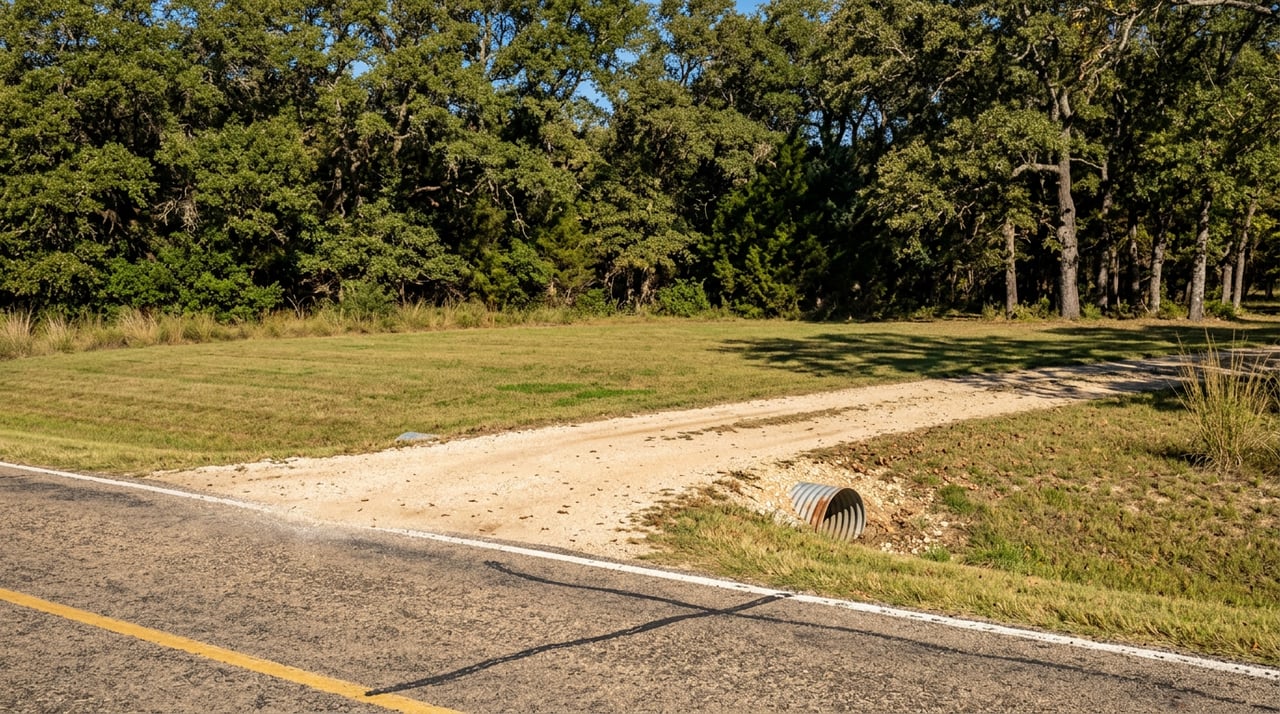
If a 2-acre lot in the Beaver Creek subdivision near Caldwell puts the drive to RELLIS at roughly 30 minutes, why does another listing for a wooded 0.93-acre lot in that same community put it at 20? Same subdivision. Same campus. A third of the estimate missing somewhere in between.
That gap is not a typo. It is what happens when a marketing phrase gets repeated across a hundred listings faster than anyone checks it against the map. "Minutes to RELLIS" has become the default line on land ads around Caldwell this year, and it is doing far more selling than measuring. The number that actually explains what a Caldwell-area tract is worth right now is not drive time. It is which road gets you there, and whether that road is the one RELLIS is actually building around.
The money behind the phrase
The reason "RELLIS" shows up on so many listings is real. Texas A&M's 2,000-acre RELLIS campus in Bryan is in the middle of the kind of capital spending that reshapes a region's commuting patterns for a generation. In February 2026, Gov. Greg Abbott appeared at the ceremonial groundbreaking for a $226 million semiconductor research facility set to open in 2028. In June 2026, Terrestrial Energy signed ground lease and R&D agreements for roughly 77 acres at RELLIS to build a small modular nuclear reactor, one of the first commercial projects of its kind in the country. A public safety training complex, an $25.3 million, 86-acre project that will relocate the TEEX Lineworker Academy and the Central Texas Police Academy, broke ground in 2025 with a target completion of May 2026. And in May 2026, the Texas A&M System Board of Regents approved a $6.8 billion five-year capital plan running through 2031, with $5.3 billion already in design or construction.
That is a genuine jobs and infrastructure story, and it is the reason Caldwell-area land listings lean so hard on RELLIS proximity as a selling point. But the campus itself sits off Highway 47 and John Sharp Parkway, not on the road most Caldwell buyers actually drive.
The road problem the drive-time number skips
Caldwell sits on Texas Highway 21, which runs 23 miles northeast into Bryan. Highway 36 bypasses the city to the northeast, heading toward Milano and Brenham. Neither road delivers you straight to RELLIS. Getting from Caldwell to the campus means covering most of that Highway 21 stretch into Bryan, then connecting over to Highway 47, the road RELLIS actually fronts.
That last-mile connection is exactly where two tracts at the same straight-line distance from Caldwell can carry different real commute times, and it is why a subdivision-wide "20 minutes" or "30 minutes" claim tends to be a rounding exercise rather than a measurement of the specific parcel. A lot with direct, paved frontage that feeds cleanly onto Highway 21 has a shorter, more predictable run into Bryan than a lot the same distance away on a county road that eventually dumps onto the same highway anyway. The subdivision name on the listing tells you less than the road the driveway actually meets.
Two current subdivisions near Caldwell make the contrast concrete:
| Community | Road access | Commute claim quoted |
|---|---|---|
| Green Hill | Paved main road into the subdivision | Under 10 minutes to Caldwell, just under 20 minutes to RELLIS |
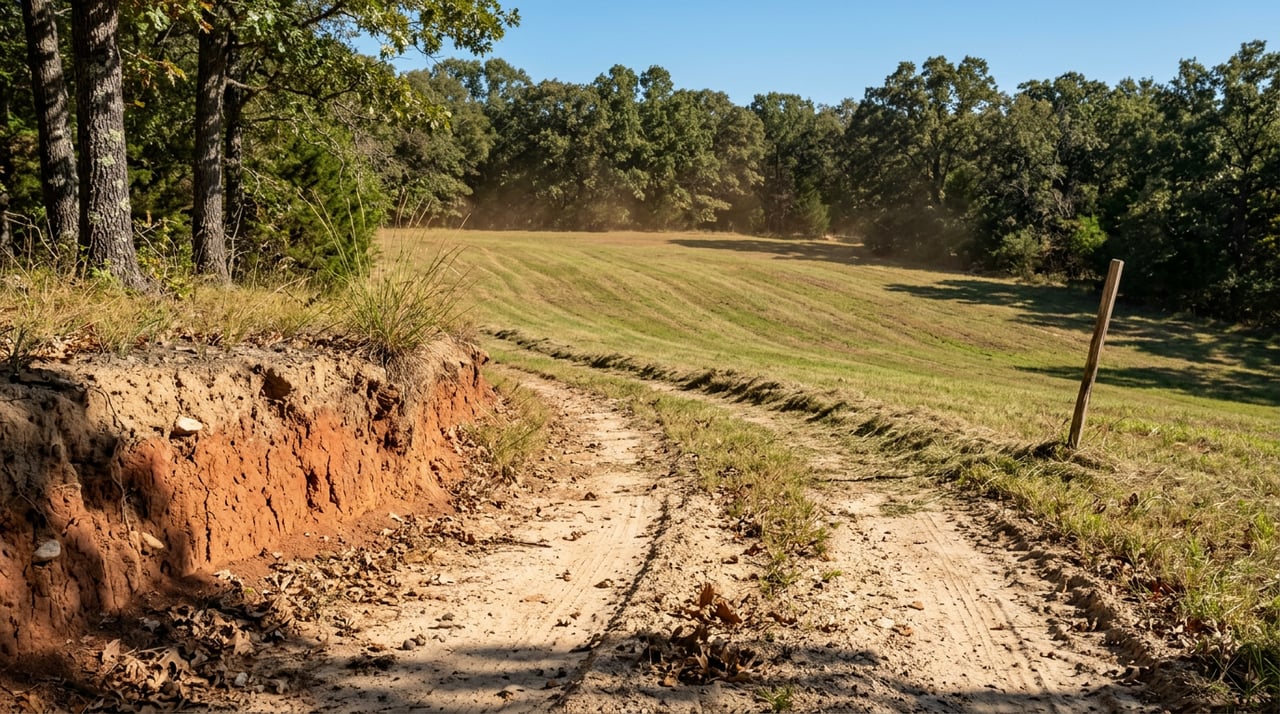
| Beaver Creek | Wooded lots off local roads | 20 to 30 minutes to RELLIS, depending on the listing |
Both communities sit near Caldwell. Only one advertises a paved road as part of its own pitch. That is not a coincidence. It is the actual mechanism buyers should be pricing in, and most listings do not separate it from the drive-time headline.
What the county averages are hiding
The confusion is not limited to individual listings. Land-portal data on Burleson County acreage this summer shows a real spread depending on which sample you pull. One portal's current figures put the median price per acre in the county at $18,176. Another puts the average cost per acre at $21,667, based on a smaller pool of active listings. Both numbers are describing the same county, in the same season, and they land nearly 20 percent apart.
That spread is not a data error. It reflects how much variance road frontage and location inside the county actually create, and how a single county-wide average smooths over the difference between a Highway 21-adjacent parcel and one three back roads removed from it. Caldwell itself already carries the most land currently listed for sale of any town in Burleson County, according to recent listing data, which means the city's own mix of frontage types is doing a lot of the work behind that spread.
Caldwell's own economic development office frames the underlying shift plainly:
"Many local jobs are being filled by people commuting from outside the area."
That is a small-town economic development office admitting its labor market already runs on commuters, not just its own residents. Add more than 20,000 vehicles a day now passing through Caldwell on Highway 21, and the traffic count alone tells you the corridor is already absorbing more daily movement than a town of under 4,000 people generates on its own. RELLIS's buildout is likely to add to that flow, not start it.
Questions worth asking before you treat a drive-time claim as fact
- Which specific road does the driveway meet, and does that road connect directly to Highway 21 or to a connector that eventually reaches it?
- Is the quoted commute time specific to this parcel, or copied from a subdivision-wide description that covers lots on multiple roads?
- Does the listing distinguish between distance to Caldwell, distance to Bryan, and distance to RELLIS itself, since those are three different destinations often blended into one number?
- Has anyone driven the actual route at a normal commute hour, rather than relied on a mapping estimate pulled at a different time of day?
None of these require a data subscription. They require pulling up the parcel on a map and tracing the actual road, which takes longer than reading a listing but tells you something the listing itself will not.
A short FAQ
Does RELLIS's growth guarantee land values will rise around Caldwell? No listing or public filing supports that as a guarantee. What the research supports is that RELLIS is actively investing in physical infrastructure at a scale that increases commuter traffic on the corridor connecting Bryan to towns like Caldwell, which is a demand driver, not a price promise.
Is Highway 21 frontage always worth more than a back-road tract at the same acreage? Not automatically. Frontage matters for access and commute reliability, but it can also mean more highway noise and less privacy, which some buyers weigh against the convenience. The point is that frontage is a variable worth pricing deliberately, not one to assume is included in a subdivision-wide drive-time claim.
Where should a buyer verify Caldwell's actual highway geography instead of relying on a listing? A simple road map or a driven test run at commute hour will show the real route far better than a rounded drive-time estimate. Public sources on Caldwell's highway layout, including its Highway 21 and Highway 36 connections, are also easy to check independently before treating any single listing's claim as settled.
If you are comparing acreage around Caldwell and want someone to walk the actual road with you before you trust the number on a listing sheet, that is exactly the kind of ground-level work Ranch House Real Estate does for every buyer. Let's grab a coffee and tour some land.