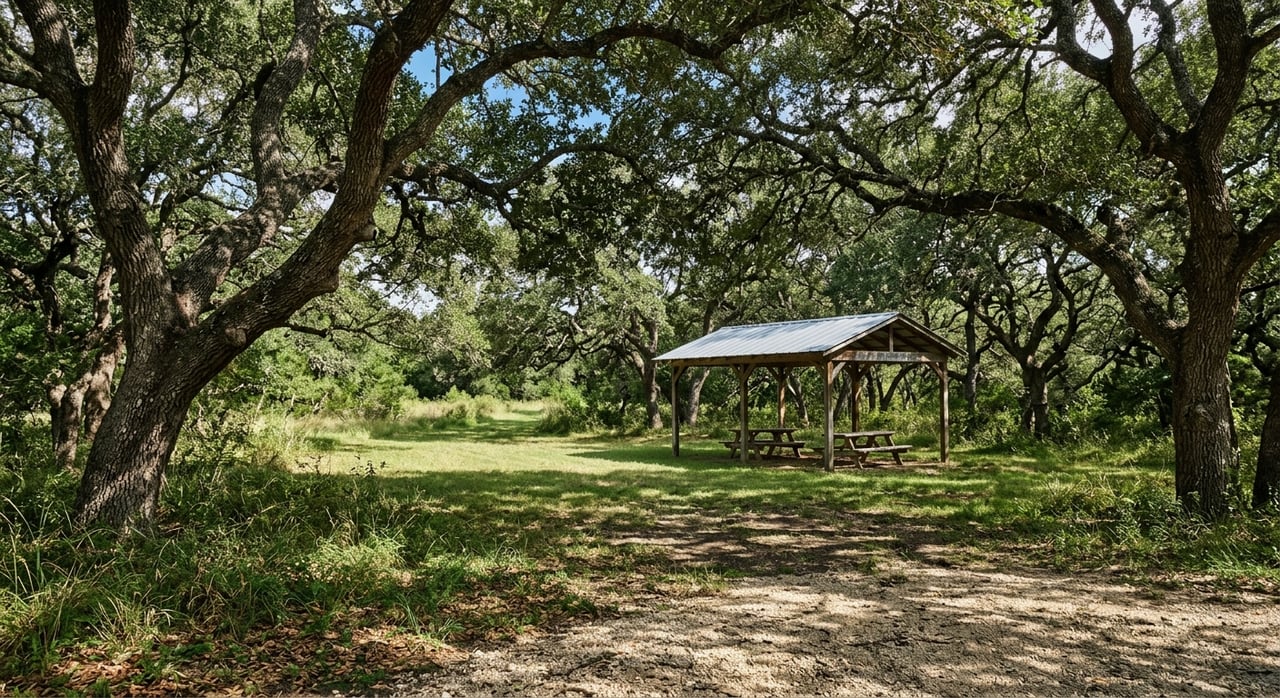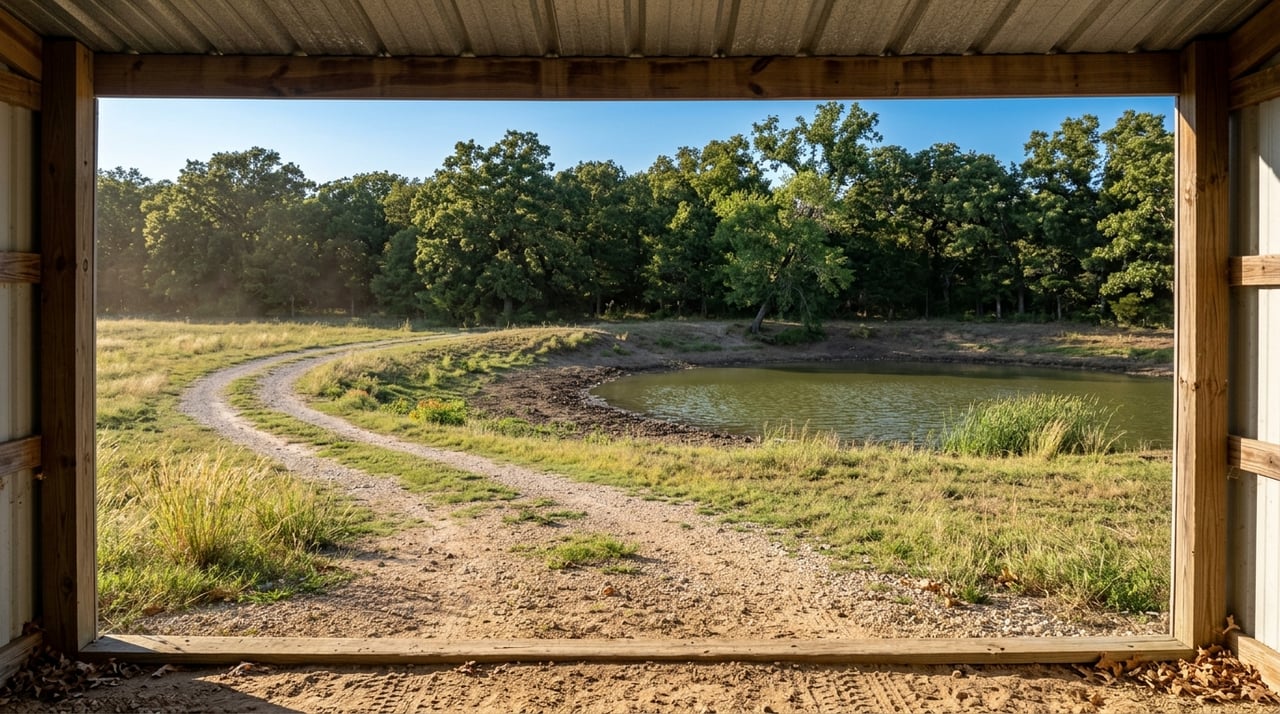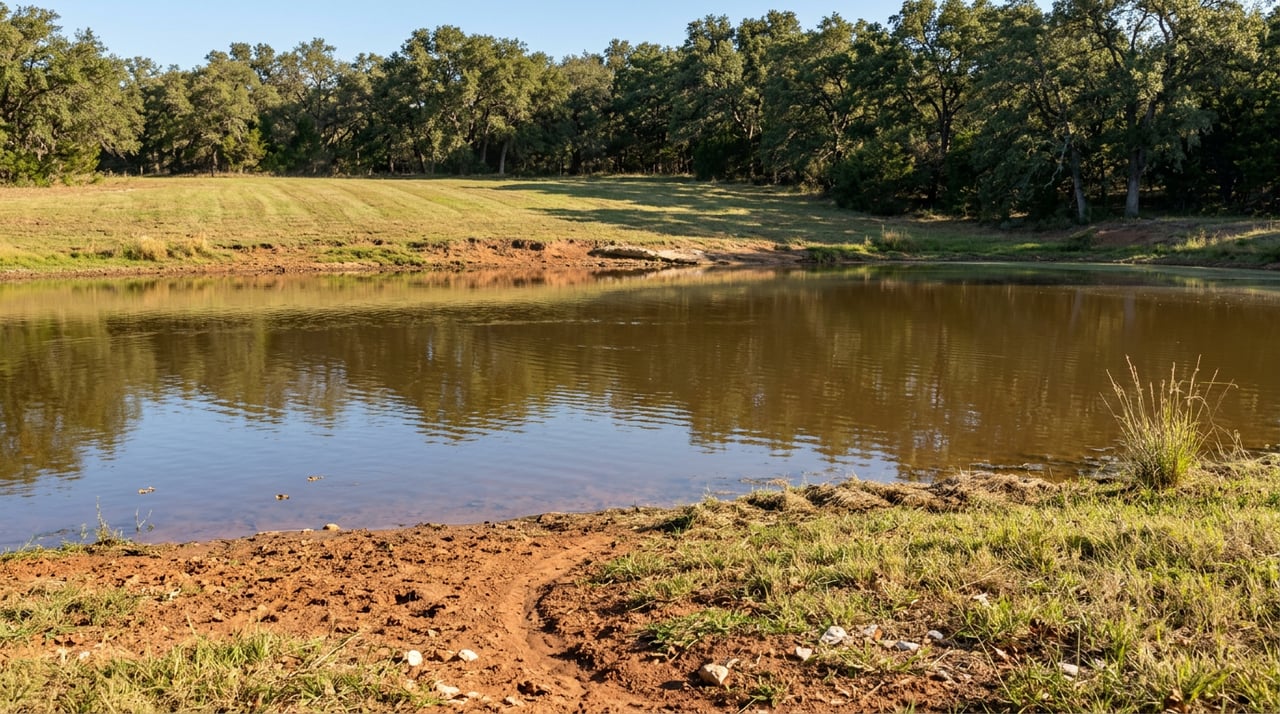
Two buyers can walk the same 40 acres outside Caldwell, agree the price is fair at the county median, and still be looking at two different properties. The difference is not the fence line or the pond. It is what the ground under them will legally give up in gallons per day, and how that number squares with what each buyer plans to do.
Groundwater in Milam and Burleson counties runs through a specific rulebook, and that rulebook does more to shape usable value out here than any comp on a portal. If you are comparing acreage tracts near Caldwell, the mechanism worth understanding before you write an offer sits at the Post Oak Savannah Groundwater Conservation District, created in Milam and Burleson counties to provide local control over groundwater resources in the central Carrizo-Wilcox area.
The number that reprices the tract
Portals will tell you Burleson County land listings average about 71 acres and a median price near $18,176 per acre, which is well above the statewide first-quarter 2026 figure of $5,246 per acre, up 6.02 percent year over year. That premium reflects proximity to Bryan-College Station, Lake Somerville, and paved county road access. What the premium does not tell you is how much of that acreage can actually be irrigated, watered for livestock, or built on for something beyond a single homestead.
Here is the ceiling most buyers do not see on the listing sheet. Under POSGCD rules, the maximum withdrawal allowed presently is 2 acre-feet per contiguous acre controlled per year. That is the working limit for a permitted, non-exempt well. On 40 acres, the math tops out at 80 acre-feet a year, which sounds generous until you price out a small orchard, a vineyard, a hay operation, or a subdivision plan against it. The tract with the better water posture is worth more per acre, even at the same list price.
What is exempt, and why "exempt" still means paperwork
Domestic use looks simple until it isn't. The relevant thresholds, straight from the district's summary of rules:
- Water wells incapable of producing more than 25,000 gallons per day for domestic or livestock uses are exempt from permitting and fees but must obtain registration prior to drilling. Drilling permits are required for all non-exempt wells.
- Drilling permits are valid for one year with a six-month extension available.
- All pre-existing wells are subject to registration.
- Production permits are issued not to exceed 40 years with a review every five years.
- A groundwater transport permit is required for water exported outside the district, with 30-year terms if construction of the conveyance system starts within three years.
- Agricultural use wells are exempt from notice and hearing requirements and fees.
Two practical points fall out of this. First, "exempt" is not "invisible." A buyer inheriting a working windmill or an older submersible still needs that well registered with the district. If the seller has not done it, the item goes on your closing checklist, not theirs. Second, the ag-use carve-out is where a legitimate ag operation buys real flexibility, which is one reason the ag exemption question and the well question are the same conversation on any working tract.
When the neighbors get a letter
If your plans push past the exempt threshold, the friction changes character. Non-exempt wells require notification to all property owners within one-half mile for a single non-exempt well, or within one mile of the proposed well locations for a well field with multiple non-exempt wells. Non-exempt well drilling and operating permits are subject to a hearing process and approval by the Board.
Read that as a transaction timeline, not a technicality. A buyer planning a commercial nursery, a small subdivision, an event venue, or any operation projecting past 25,000 gallons a day should assume a notice-and-hearing window between contract and full permit clearance. The right move is either a feasibility contingency built around the district's calendar, or a due diligence period long enough to submit the application before closing so the water question does not outlive the earnest money.
Spacing rules add a second layer, especially on tracts with existing production nearby. In the Simsboro formation, spacing for a new well is set at one foot per gallon per minute of production capacity from any existing well in that formation, and one-half foot per gallon per minute from the property line, at the applicant's election when the permit application is filed. Translate that on the ground: a proposed higher-capacity well near a shared property line can be a non-starter without a neighbor conversation, and the location of the drill pad is a negotiable feature of the tract before you close, not after.
Why locals watch water levels
Buyers new to Milam and Burleson counties sometimes ask why long-time landowners speak about aquifer levels the way coastal owners speak about tides. The answer is that the district sits over water other people are paying to move. The Vista Ridge project transmits water from a well field in Burleson County, Texas, through a 142-mile pipeline, with an amended and restated drilling and operating permit and an amended and restated transport permit. In February 2020, Vista Ridge amended its permit to 55,835 acre-feet per year. On the industrial side, ALCOA was issued a 25,000 acre-foot-per-year permit for on-site industrial use in November 2012, and in August 2021 that permit was amended to municipal use with a transport permit issued.
None of that changes your exempt-well registration. It does explain why the district monitors water levels closely, why long-lease production forecasts matter to a small landowner, and why the ability to prove your well's condition and yield at closing is worth doing rather than assuming. The Groundwater Well Assistance Program, adopted in January 2018, assists landowners in exchange for access to wells for continued water level measurements. On the right tract, participation is a small favor that pays back in data.
A field trip worth putting on the calendar
If you are shopping seriously in the Caldwell market this summer, the highest-leverage two hours you can spend is at the district's own event. The 12th Annual Groundwater Summit is scheduled for Thursday, August 6, 2026, from 9 a.m. to 4:30 p.m. at the Caldwell Civic Center. The agenda this year is aimed at non-specialists. The Summit is built around the question of what happens when growth moves faster than the plans built to manage it, covering population growth, industrial development, and new water-intensive projects, with speakers explaining what is happening with groundwater in the region, what information the district uses to make decisions, and what those decisions mean for landowners, well owners, communities, and future growth.
Sitting through a session before you make offers on multiple tracts is cheaper than learning the same material by mistake after closing.
What this means at the offer stage
A short checklist that reflects how we work these transactions on the ground:
- Ask the seller for the POSGCD registration on every existing well, plus the most recent water-level and yield notes if available.
- Match your intended use against the 25,000 GPD line before you set your due diligence window. Anything commercial, high-density residential, or seriously agricultural belongs above the line and should be treated as a permit timeline problem, not a paperwork one.
- Confirm any transport, export, or historic-use permit tied to the tract. Historic use permits, based on maximum annual use prior to 2004, are good for the life of the well. Those carry value that will not show up on a standard listing description.
- If the tract is ag-exempt or should be, treat the ag exemption and the water plan as one file. Losing the ag exemption changes both tax posture and the well category you can defend.
The per-acre number on the listing is the beginning of the conversation, not the answer. In Burleson County, water posture is the multiplier that decides whether a tract at $12,000 per acre is a bargain or fully priced, and whether a tract at $22,000 is worth stretching for.
A short FAQ
Do I need a new permit if I only plan to water livestock and irrigate a garden? Usually no permit, but yes to registration. Domestic and livestock wells staying under the 25,000 GPD ceiling are exempt from permitting and fees but still have to be registered before drilling, and pre-existing wells have to be registered as well.
How long does a non-exempt permit realistically take? Long enough to plan for. The application triggers neighbor notification and a Board hearing, and the drilling permit itself is valid for one year with a six-month extension available. Build the calendar into your contract, not around it.
Does the district have eminent domain? No. The district does not have the authority granted by Section 36.105, Water Code, relating to eminent domain.
Where do I actually go with questions? Start with the district's public maps and rules, then plan to attend the August Summit at the Caldwell Civic Center. Bringing a plat and a use plan to a real conversation beats reading rules cold.
Water is the quiet part of a rural closing in Milam and Burleson counties, and it is where a broker who knows the district earns their fee. If you are looking at acreage around Caldwell and want to run your plans past someone who has walked these tracts and read these permits, Ranch House Real Estate is a phone call away. Let's grab a coffee and tour some land.