You found the tract. The listing price pencils out. The portal shows five recent sales inside a mile that support the number. Then the site evaluator comes back with a soil boring report, and the build budget moves by five figures before anyone has poured a slab.
Around Caldwell, the item that most often moves that number is the septic system. Not the roof, not the well, not the driveway. And the reason is a mix of a state rule buyers keep misreading, a soil profile that closes off the cheap option, and a county process that quietly attaches a maintenance obligation to the deed.
The exemption the listing sheet is quoting probably doesn't apply here
The state rule people repeat at the coffee shop is real. Under 30 TAC Chapter 285, an on-site sewage facility can be exempt from formal permitting if it serves a single-family dwelling on a tract of ten acres or larger, every part of the system sits at least 100 feet from every property line, and no effluent crosses the line. On paper, that describes a lot of Burleson County acreage.
In practice, the Brazos Valley counties have closed that door. Licensed installers working the seven-county region report that in every county except Robertson, an OSSF requires a permit regardless of acreage, and Robertson is working to close its own gap. Burleson County's own OSSF Order Justification argues that dwelling density and lot size are the primary drivers of failure, and the county adopted "higher lot size standards" and other "more stringent standards" on top of the state minimums. If your agent, seller, or builder is pricing the tract as if the ten-acre rule applies, that is the first assumption to test.
Two consequences follow that a portal median will never show you. First, minimum lot size for a residential OSSF in Burleson County runs roughly one acre with public water and two acres without, so a small "unrestricted" lot without a water line is not automatically buildable. Second, the county requires a 911 address verification letter before the OSSF permit application can even be filed, which adds a step most out-of-area buyers don't know to sequence into the option period.
What the claypan decides for you
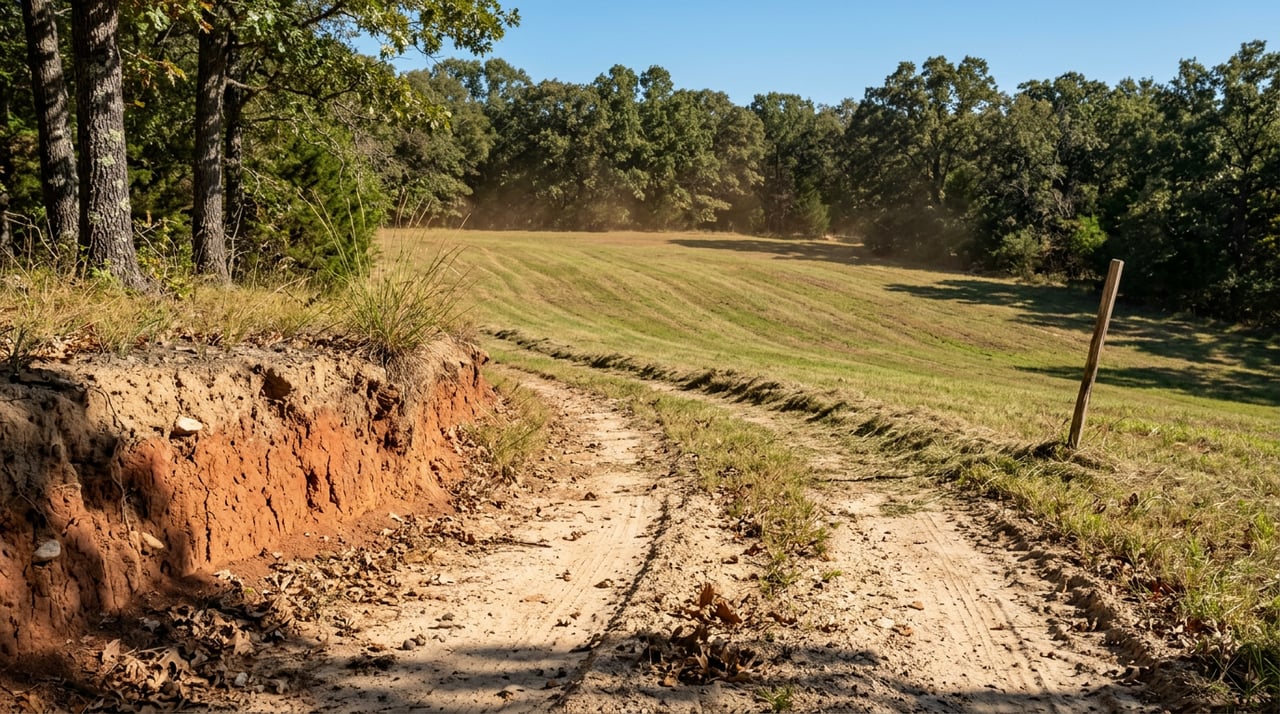
Central Texas soils don't cooperate with the cheapest septic option. Cast Environmental Services, a licensed installer working across the Brazos Valley, describes the regional profile plainly: the surface is often sandy or sandy loam, but a dense clay subsoil, the Texas Claypan under the Post Oak Savannah, sits a few feet down and is nearly impervious to water. A conventional gravity drain field needs the water to move down through the soil. When it can't, the design won't percolate, and the design won't get permitted.
That is why so many new rural installations in the region are aerobic treatment units, drip irrigation, or sand mound systems rather than conventional tank-and-field setups. Statewide, roughly half of new OSSF installs are aerobic. On a Caldwell-area tract with clay-heavy soil, the number is higher in practice.
The pricing consequence is direct. Regional installers put a conventional system on a favorable Brazos Valley site in the rough neighborhood of the low-to-mid five figures, and aerobic or engineered alternatives sit meaningfully above that, with an ongoing maintenance contract layered on top. When two seemingly comparable tracts near Caldwell trade at different per-acre prices, the soil profile behind the treeline is often doing more of the work than the road frontage.
The permit sequence, and who owns each step
The order of operations matters, because each step has a gatekeeper and its own clock. Below is the sequence a buyer planning to build near Caldwell should expect, from the point of getting under contract.
| Step | Who owns it | What triggers the next step |
|---|---|---|
| 911 address verification letter | Burleson County (issued in Caldwell) | Letter in hand unlocks the permit application |
| Preconstruction site evaluation | Licensed Site Evaluator or professional engineer | Two soil borings or backhoe pits, plus a setback survey |
| System design | PE or licensed sanitarian | Design must satisfy Chapter 285 setbacks and county overlays |
| OSSF permit application | Owner or installer, filed with Burleson County Environmental | County has 30 days to approve or deny in writing |
| Install | Licensed OSSF Installer | Authorization to Construct expires in one year if idle |
| Final inspection | County inspector | Sign-off allows the system to be placed into service |
| Aerobic maintenance contract | Owner, with a licensed Maintenance Provider | Two-year initial contract; three inspections per year |
Two items on that table catch buyers off guard. The site evaluation is not a formality. It is a licensed professional drilling or digging into the disposal area and confirming, in writing, that the soil and setbacks work for the system the design proposes. A design that violates a Chapter 285 setback from a well, water line, structure, property line, or surface water simply won't get issued. On tighter tracts, that setback math is what determines whether a home can go where the buyer wants it, or at all.
The other is the 30-day clock. The permitting authority is required to approve or deny within 30 days of receipt, but a denial for missing information restarts the practical clock. That timing rarely fits inside a 30-day option period unless the site evaluation is already in motion.
The paperwork that follows the deed
Aerobic systems come with an obligation that outlives the closing. Every new aerobic install in Texas requires a two-year initial maintenance contract with a licensed Maintenance Provider, with three inspections per year, or every six months if the system carries qualifying electronic monitoring.
That contract is not a private matter between the homeowner and the provider.
A notarized affidavit-to-the-public is filed with the County Clerk for any system requiring a maintenance contract. It puts the maintenance obligation on the property record so future buyers are on notice.
For a buyer, that means two things. If the tract you are buying already has an aerobic system, there should be a recorded affidavit and a current maintenance contract, and both should show up in a clean title review. If the tract does not have a system yet, plan on that affidavit joining your own deed once the new system is installed. It is not a lien, but it is a public record that a future buyer, their lender, and their inspector will read.
Questions to get answered before the option period ends
The friction above is workable when it's surfaced early. It becomes a repricing event when it surfaces late. A short diligence list, aimed at Burleson County acreage:
- Is there an existing OSSF permit on file for this tract with the county Environmental office at 100 W. Buck in Caldwell, and does the permitted system match what is physically on the ground?
- If aerobic, is there a recorded maintenance affidavit, a current maintenance contract, and inspection records from the last two years?
- Does the tract meet Burleson County's minimum lot size for the water source available: roughly one acre with public water, two without?
- Has a licensed Site Evaluator or PE done a soil evaluation for the proposed home site, and does the disposal area percolate for a conventional system or does it require aerobic, drip, or a sand mound?
- Do the intended home location, well location, and any pond or creek line preserve the Chapter 285 setbacks the design will need?
- If the tract is unaddressed, is a 911 address verification letter already in motion?
- Does the seller have any prior denial correspondence from the county on an OSSF for this tract? A prior denial is a live piece of information, not a dead file.
None of these questions require the buyer to be a septic expert. They require the buyer to know which door to knock on before the option period runs out.
A short FAQ
Does the ten-acre rule ever help me in Burleson County? Rarely. The state exemption still exists in Chapter 285, but Brazos Valley counties, Burleson included, have adopted local orders that effectively require a permit regardless of acreage. Treat the exemption as unavailable until the county's Environmental office confirms otherwise in writing.
Can I install a conventional system on a Caldwell-area tract? Sometimes. It depends on what the site evaluator finds below the sandy topsoil. If the claypan is shallow or the seasonal water table is high, the design will point toward aerobic or drip. The soil evaluation, not the listing description, decides.
How long should I budget between going under contract and having a permit in hand? The state gives the county 30 days to approve or deny a complete application, and regional installers describe first-call-to-final-inspection windows of roughly five to eight weeks on a straightforward new install. Option periods often need to be structured around that timing, not compressed into it.
Who actually issues the permit? Burleson County Environmental, in Caldwell at 100 W. Buck Street, Suite 303, acts as the authorized agent under state rules. The site evaluation and design come from a licensed private professional. The install comes from a licensed installer. The county reviews, permits, and inspects.
Is the maintenance affidavit a lien? No. It is a notice filed with the County Clerk that the property carries an aerobic system with an ongoing maintenance requirement. It doesn't cloud title in the way a lien does, but it is a piece of the public record a future buyer will find and read.
Rural land near Caldwell rewards the buyer who reads the soil before reading the comps. If you are working through a specific tract and want a second set of eyes on the septic, water, and setback questions before your option period closes, Ranch House Real Estate would be glad to walk the property with you. Let's grab a coffee and tour some land.