If you are looking at land around Caldwell, the big question is not just whether acreage is cheaper than in larger nearby markets. The real question is whether the property can actually do what you want it to do. For many land investors, that is where the opportunity and the risk both show up.
Caldwell sits in a part of Central Texas where land still plays a major role in the local market, and that matters if you are thinking about a long-term hold, a homesite split, or a small rural development play. At the same time, county rules on frontage, lot size, water, septic, and access can quickly change the math. This guide walks you through what makes Caldwell appealing, what can slow a project down, and how to think about land here with clear eyes. Let’s dive in.
Why Caldwell Gets Investor Attention
Caldwell stands out because it sits in a rural county that is growing, but still has a land-heavy character. The U.S. Census Bureau estimates Burleson County at 20,549 residents in 2025, up 16.5% from 2020, while nearby Brazos County reached an estimated 249,624 residents in 2024, up 6.7% from 2020. That combination gives you a market with room to grow and nearby regional demand, especially from the Bryan-College Station orbit. See the latest Burleson County population data from the Census Bureau.
The county also has a strong land inventory profile. According to the Burleson County Appraisal District 2024 annual report, the district appraised about 80,146 parcels in 2024, including 4,745 vacant lots and tracts, 6,946 qualified ag land parcels, and 6,655 non-qualified ag land parcels. That kind of parcel mix supports the idea that this is still a place where acreage, farm, ranch, and future-use tracts matter.
For investors, that can be attractive because the market is not built out in the same way as a suburban county. You may find more options for hold strategies, homesite creation, or carefully planned rural subdivision work. But the tract itself has to fit the rules.
SH 21 Adds Long-Term Interest
Road access matters in rural land markets, and Caldwell has an important position along State Highway 21. TxDOT is improving SH 21 intersections at FM 50 South, FM 50 North, and OSR in Burleson and Brazos counties, with work starting in early 2025 and expected to finish in mid-2026.
TxDOT says these improvements are intended to improve safety and operations. A separate SH 21 study also notes future traffic demand tied to population growth in fast-growing communities. That does not guarantee any one tract will increase in value, but it does support the idea that this corridor is important to how the region functions.
Burleson County also uses the SH 21 and SH 36 intersection in Caldwell as the county grid reference point for addressing. That is another sign of how central those roadways are to local access and navigation. For land investors, corridor relevance can be a plus, especially if you are thinking long term.
The Smart Move Depends on Your Strategy
Caldwell can make sense for land investors, but not for every type of investor. It may be a better fit if you are comfortable evaluating entitlement risk, utility constraints, and road-access details before you buy.
In simple terms, Caldwell often looks strongest for investors who fall into one of these buckets:
- Long-term hold buyers who want land in a rural county with growth nearby
- Homesite split buyers who are looking for tracts with usable frontage and enough acreage to divide legally
- Small-scale developers who can budget for platting, access, water, and septic planning
If your plan depends on quick, low-cost subdivision, you need to be especially careful. Burleson County rules create real limits on what can be split and how fast it can move.
Lot Size Rules Shape the Deal
One of the first things to understand is how Burleson County separates urban and rural land. Under the county’s Subdivision Regulations, urban subdivisions are lots under 1 acre, while rural subdivisions are lots of 1 acre or more.
That matters because minimum lot size for a new single-family setup depends on water access. The county says you generally need:
- 1 acre minimum when public water is available
- 2 acres minimum when access depends on a private well
Some older plats created before November 1, 2023 may fall under smaller legacy standards in certain cases. Still, for most new planning, current standards are what matter most.
If you are underwriting a land purchase based on future splits, these size rules should be part of your first-pass review. A tract that looks large enough on paper may still produce fewer legal homesites than you expect.
Frontage Can Make or Break Value
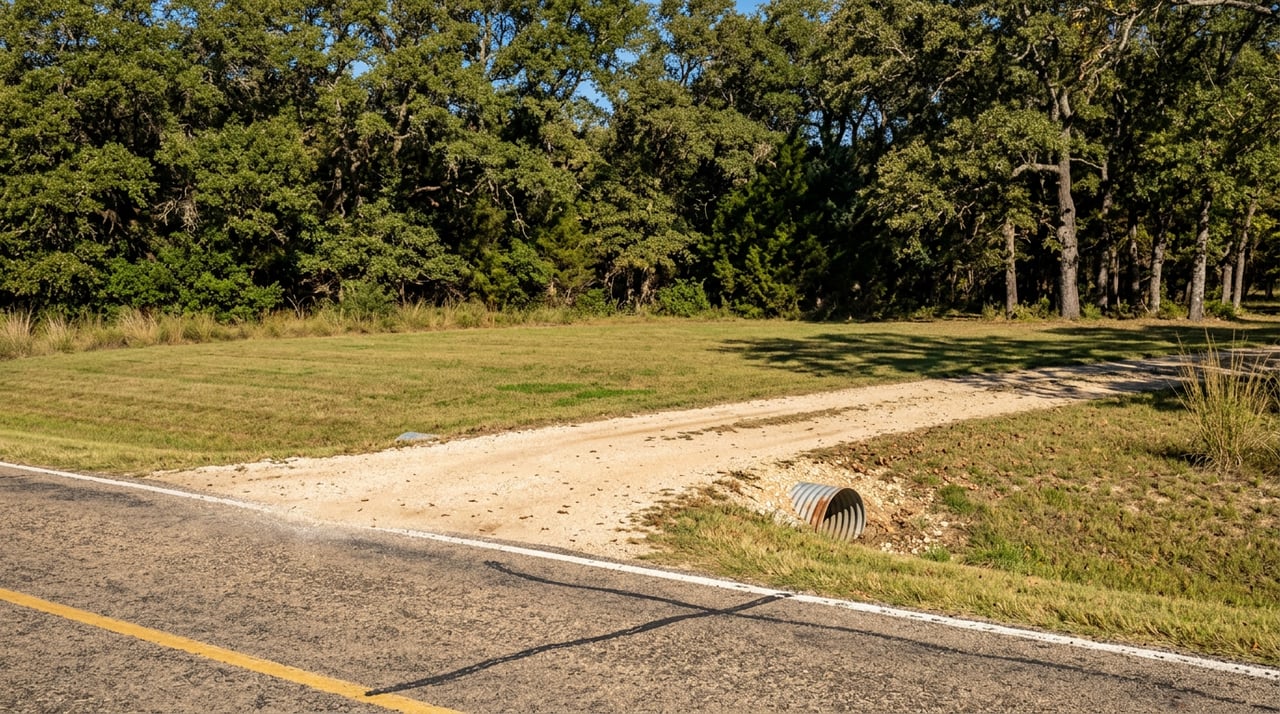
In Caldwell and across Burleson County, frontage is one of the biggest land-investment filters. The county says lots generally need at least 100 feet of road frontage, or 70 feet in the bulb of a cul-de-sac. That requirement alone can limit the number of legal splits on a tract.
The county also outlines a common split exception with specific conditions. The daughter tract must be at least 2 acres, the remaining parent tract must contain at least 10 acres, and all tracts must still have at least 100 feet of frontage. These are not small details. They can directly affect whether your exit strategy works.
This is why two tracts with the same acreage may have very different investment value. One may have clean road frontage and flexible access. The other may be landlocked from a subdivision standpoint, even if it looks appealing in an aerial view.
Utilities and Water Need Early Review
A good-looking tract is not enough if water and wastewater planning do not line up. Burleson County requires a pre-development meeting and plat materials that include water availability, planned sewage, floodplain study, drainage plan, TxDOT access permits when applicable, and city approval if the property is inside a city ETJ.
The county’s current fee schedule includes:
- $3,000 plus $100 per lot for a subdivision plat
- $100 for a simplified plat
- $80 for county-clerk filing
The county also notes that road-name mapping and address validation for new developments can take 3 to 4 weeks. That may not sound major, but it affects timelines and carrying costs.
For septic planning, Burleson County says OSSF materials must be approved or denied within 30 days after receipt. The county’s environmental guidance also reinforces the 1-acre rule with public water and the 2-acre rule with private well access.
Well Rules Add Another Layer
If your tract will rely on private wells, there is another issue to review before you assume a split will work. Burleson County falls under the Post Oak Savannah Groundwater Conservation District, and the district says applicants planning to use exempt wells as the main water source must meet with the district before submitting a plat.
Its 2024 rules set minimum tract size per well based on aquifer location. The standard may be 10 acres for some aquifers, 5 acres for others, 3 acres for Carrizo, and 2 acres for Simsboro, along with spacing requirements from property lines.
That means water feasibility is not just about having enough total acreage. It can also depend on where the tract sits and which aquifer applies. For investors, this is one of the clearest reasons to verify the site before building a subdivision model.
City Limits and ETJ Change the Rules
Not all Caldwell land follows the same path. If a property is within Caldwell city limits, the city has authority. If it is in the ETJ, the city is also involved, according to the county’s environmental guidance.
Inside the city, the utility picture may be more favorable for some uses. The City of Caldwell’s utilities page lists water and sewer service, with electric providers including Bluebonnet Electric, BTU, and Entergy, along with Atmos and telecom options. The city also says it has updated subdivision regulations and infrastructure design standards and is developing a zoning ordinance.
For investors, that means your due diligence should always include location context. A tract inside city limits, in the ETJ, or fully in the county can have very different approval paths, utility options, and development costs.
Rising Values Support Interest
Burleson County is still rural, but valuation trends show that pressure is building. The Burleson CAD 2024 annual report says total market value rose to $8.66 billion in 2024, and average single-family residence value increased to $241,341.
That is not the same thing as land comps. Still, it helps explain why acreage near travel corridors and regional job access can attract both long-term hold buyers and smaller development interest. When values rise in a county that still has a large land base, investors usually pay closer attention.
A Practical Way to Underwrite Caldwell Land
If you are considering land in Caldwell, focus less on price per acre and more on usable potential. A smart review usually starts with a few practical questions:
- Does the tract have enough road frontage for your plan?
- Will the project need public water, private wells, or on-site septic?
- Is the property in city limits, the ETJ, or only under county rules?
- Does access from a state roadway require a TxDOT permit?
- Is any part of the site affected by floodplain or drainage issues?
- Do the lot sizes still work after applying county and groundwater district rules?
This is where local land experience matters. Rural property can look simple from the outside, but the real value often depends on details that do not show up in a basic listing search.
So, Is Caldwell a Smart Move?
For the right investor, yes, Caldwell can be a smart move. The area offers a land-oriented market, regional growth influence, and road-corridor investment that can support long-term demand. But the best opportunities usually go to buyers who understand that frontage, utilities, water sourcing, and local approvals matter just as much as acreage size.
If you want help sorting through tract potential, rural land constraints, and what a property may realistically support, Ranch House Real Estate can help you look at the details before you make a move. Let’s grab a coffee and tour some land.
FAQs
Is Caldwell, Texas good for raw land investment?
- Caldwell can appeal to raw land investors because Burleson County has a strong inventory of vacant, agricultural, and acreage tracts, plus regional growth influence from nearby Brazos County and improvements along SH 21.
What makes land in Caldwell hard to subdivide?
- The biggest hurdles are often minimum lot sizes, road frontage requirements, water source rules, septic planning, ETJ review, and access permits for certain roads.
How much road frontage do you need to split land in Burleson County?
- Under Burleson County subdivision rules, lots generally need at least 100 feet of road frontage, though cul-de-sac bulbs may allow 70 feet in some cases.
Do private wells affect subdivision potential in Caldwell?
- Yes. If a tract will rely on private wells, the Post Oak Savannah Groundwater Conservation District rules may set minimum tract sizes per well based on the aquifer and spacing requirements.
Is land inside Caldwell city limits different from county land?
- Yes. Land inside Caldwell city limits may have access to city water and sewer, while property in the ETJ or county may face different approval processes, utility options, and development standards.